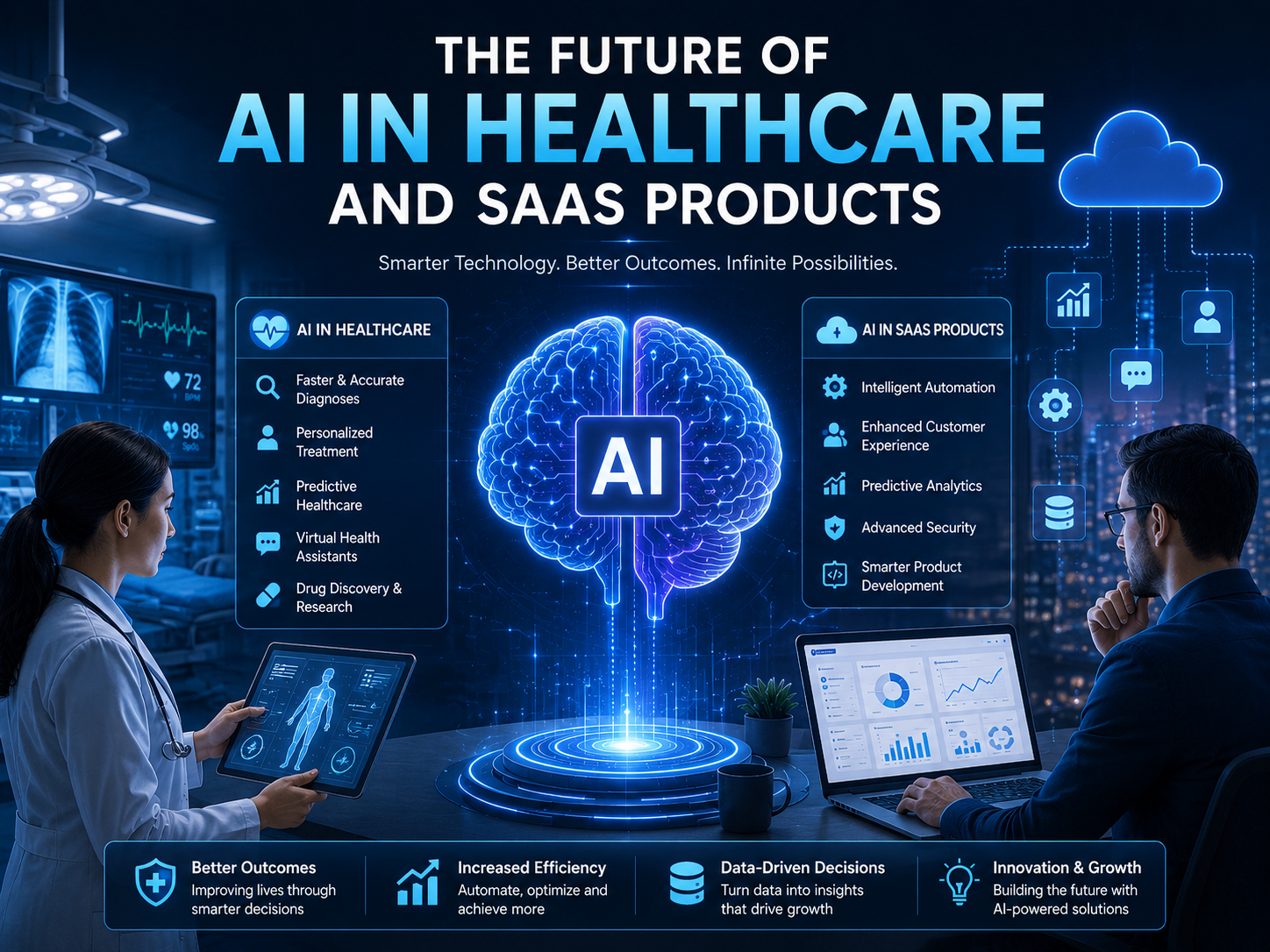
Artificial Intelligence (AI) is rapidly transforming industries across the globe, and two sectors experiencing the most significant impact are Healthcare and Software-as-a-Service (SaaS). In 2026, AI is no longer an experimental technology—it has become a core component of digital transformation strategies for organizations seeking greater efficiency, innovation, and competitive advantage.
Healthcare providers are leveraging AI to improve patient outcomes, streamline operations, and accelerate medical research. At the same time, SaaS companies are integrating AI capabilities into their platforms to automate workflows, enhance user experiences, and deliver smarter business solutions.
This article explores how AI is shaping the future of healthcare and SaaS products and what businesses can expect in the years ahead.
Artificial Intelligence refers to technologies that enable machines to simulate human intelligence, including learning, reasoning, problem-solving, and decision-making.
Key AI technologies include:
These technologies allow businesses to process vast amounts of data, identify patterns, and automate complex tasks that previously required human intervention.
Healthcare organizations are increasingly adopting AI to enhance patient care and operational efficiency.
AI-powered healthcare solutions help providers:
By analyzing medical records, imaging scans, and patient histories, AI systems can assist healthcare professionals in delivering more accurate and timely care.
As healthcare demands continue to grow, AI will play a crucial role in supporting medical professionals and improving access to quality care.
One of the most impactful applications of AI in healthcare is medical diagnostics.
AI algorithms can analyze:
These systems can identify abnormalities with remarkable accuracy, assisting doctors in detecting diseases such as cancer, heart conditions, and neurological disorders at earlier stages.
Early detection often leads to more effective treatment and improved patient outcomes.
The rise of telemedicine has accelerated the adoption of AI-driven remote monitoring solutions.
AI-enabled platforms can:
These solutions reduce hospital visits while ensuring continuous patient care and monitoring.
As wearable devices become more advanced, AI-powered healthcare ecosystems will become increasingly common.
Developing new medications traditionally requires years of research and significant financial investment.
AI is helping pharmaceutical companies:
By automating complex research processes, AI can significantly accelerate drug development and bring life-saving treatments to market faster.
AI is also transforming the SaaS industry by enabling software platforms to become more intelligent, adaptive, and user-centric.
Modern SaaS products leverage AI to:
Businesses increasingly expect software solutions that not only manage data but also generate actionable insights.
One of the biggest advantages of AI-powered SaaS products is workflow automation.
AI can automate:
This reduces manual effort, minimizes errors, and allows teams to focus on strategic activities.
Organizations can achieve greater productivity while reducing operational costs.
Modern users expect software that understands their needs and preferences.
AI enables SaaS platforms to:
Personalization improves user satisfaction, engagement, and retention while increasing the overall value of the product.
Customer support is one of the most common AI use cases in SaaS applications.
AI-powered chatbots and virtual assistants can:
These systems improve customer satisfaction while reducing support costs and response times.
AI-powered SaaS platforms increasingly rely on predictive analytics to help businesses make smarter decisions.
Predictive analytics can:
Organizations can proactively respond to opportunities and challenges before they occur.
While AI offers significant benefits, organizations must address several challenges:
Healthcare and SaaS platforms handle sensitive user information that must be protected through strong security measures and compliance frameworks.
Algorithms must be trained responsibly to prevent biased outcomes that could negatively impact users or patients.
Organizations should clearly communicate how AI systems make decisions and process data.
Healthcare providers and SaaS companies must comply with evolving regulations governing AI usage and data protection.
Several emerging trends will shape the future of AI:
AI assistants will become increasingly capable of performing complex tasks, generating reports, and supporting decision-making.
AI systems will automatically manage entire business processes with minimal human intervention.
Treatment plans will be customized using real-time patient data and predictive analytics.
Future SaaS platforms will function as intelligent business partners, providing recommendations and automated actions based on user goals.
Healthcare providers will use AI to predict disease risks before symptoms appear, enabling preventive care strategies.
Organizations that invest in AI today gain several advantages:
Early adopters are already seeing measurable benefits from AI-driven transformation initiatives.
Artificial Intelligence is redefining the future of healthcare and SaaS products. From improving patient care and accelerating medical research to automating business operations and enhancing software experiences, AI is becoming a fundamental driver of innovation.
As technology continues to evolve, businesses that embrace AI responsibly and strategically will be better positioned to deliver exceptional value, improve operational performance, and remain competitive in an increasingly digital world.
The future of healthcare and SaaS is intelligent, connected, and powered by AI.


Software Development you can trust. Mohali india, Servicing clients worldwide. We are a team of passionate developers, designers, and strategists dedicated to crafting exceptional digital experiences.